


Compatibility of Pre-insulated Pipe Systems in District Heating Network Modernisation and Expansion
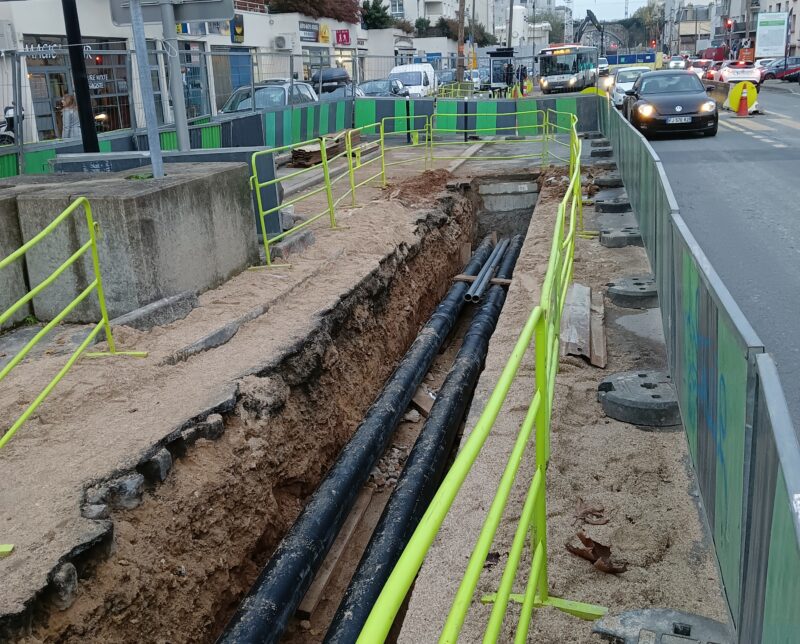
In engineering practice, the modernisation and extension of district heating networks frequently require the integration of new pipeline sections into existing district heating networks executed in the technology of another manufacturer. In such cases, it is essential to define the technical conditions under which pre-insulated systems can be safely connected in compliance with applicable standards.
Compatibility does not result solely from a similar layered structure (steel service pipe, PUR insulation, HDPE casing). It is determined by normative compliance, as well as the geometric and mechanical compatibility of the analysed system.
Compliance with EN 13941
The design basis for buried pre-insulated district heating networks is EN 13941-1 (design) and EN 13941-2 (installation). These standards define the methodology for considering temperature, pressure and friction loads, specify project classes, permissible stress levels, and rules for thermal expansion compensation. They also regulate installation requirements and soil conditions.
Radpol Pipes pre-insulated system components are manufactured in accordance with system standards, in particular EN 253, EN 448, EN 488, EN 489 and EN 14419. This means they may be used in networks designed in accordance with the guidelines of other manufacturers, provided that the base design was developed in compliance with EN 13941.
If the existing network was designed according to earlier guidelines or based on different calculation models, verification of the adopted design assumptions is required prior to integrating a new section.

Geometric Compatibility
Dimensional conformity of system components is the fundamental condition for connection. The nominal diameter DN is not a sufficient criterion for assessing compatibility. It is necessary to verify the outside diameter of the steel pipe in accordance with EN 10220, wall thickness, the outside diameter of the HDPE casing, and the insulation series, as different insulation thicknesses result in changes to the casing diameter. Manufacturing tolerances are also relevant.
Differences in casing diameter directly affect joint selection and the design of transition solutions. Shortening sleeves in order to compensate for dimensional differences is not permissible.
In the case of twin pipe systems, additional analysis is required regarding the centre spacing of service pipes, system symmetry, pipe diameters within the assembly, and the routing of alarm wires. Lack of geometric compatibility necessitates the use of individually designed transition elements.
Mechanical Aspect and Project Classes
In accordance with EN 13941, projects may be executed as Class A (simplified method, subject to specified diameter and stress conditions) or Class C (full mechanical stress calculations).
The integration of a new section into an existing district heating network alters the static scheme of the analysed pipeline segment. Verification of temperature and friction forces, slip zone lengths, the location of natural anchor points, and maximum axial stresses in the steel pipe is required.
If the existing section operates as a self-compensating system, modification of pipeline length or insulation parameters may significantly affect stress distribution. In such cases, recalculation in accordance with the standard requirements is recommended.
Leak Detection and Alarm System
Pre-insulated pipe systems may be equipped with either a resistance-based or impulse alarm system in accordance with EN 14419. When connecting systems from different manufacturers, the type and cross-section of alarm wires, their unit resistance, and the configuration of the measuring loop must be analysed.
Without verification of electrical parameters, a new section should not be directly connected to an existing monitoring loop. In certain cases, adaptive solutions or reconfiguration of the supervision system may be required.
Transition Zone Between Systems
The connection zone between two systems is an area of particular technical importance. Potential differences may occur in system stiffness, casing diameter, and alarm system routing. The transition design should address both geometric requirements and the analysis of pipeline behaviour in soil.
A transition element should not be treated solely as an installation detail, but as a structural component of the system requiring engineering analysis.
Conclusions
Radpol Pipes pre-insulated pipe systems may be connected with systems of other manufacturers provided that compliance with EN 13941 is maintained, geometric compatibility is ensured, and mechanical verification of the analysed section is performed. Compatibility of the leak detection system must also be verified.
Compatibility assessment should not be based solely on nominal diameter conformity, but on a comprehensive engineering analysis covering geometric, mechanical and system aspects.
Share


